
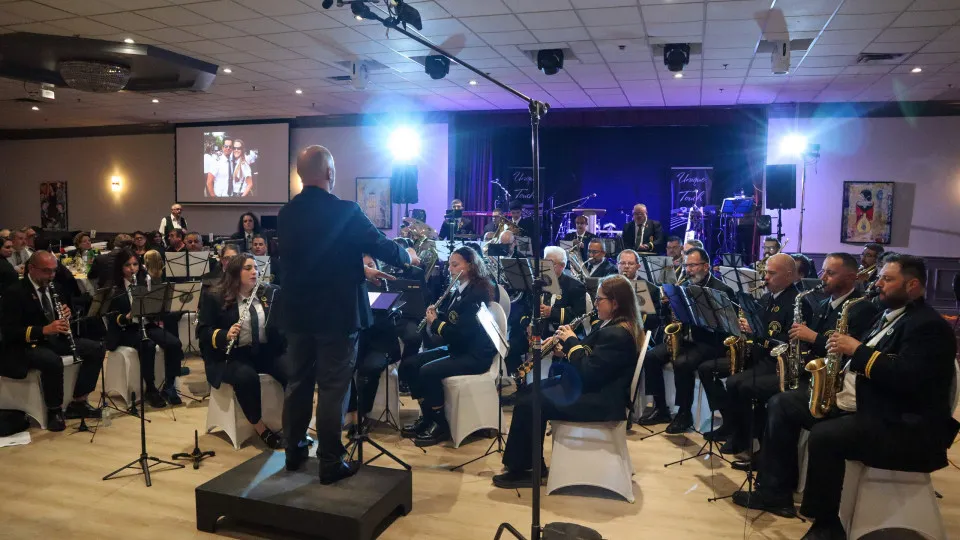
The oldest Portuguese band in Canada celebrated on Saturday 60 years, joining musicians who arrived during the emigration of the 1960s to young Portuguese-Canadians who continue to preserve tradition.
© Lusa
25/10/2026
by
Lusa
A the oldest Portuguese band of Canada celebrated on Saturday 60 years, uniting musicians who arrived during the emigration of the 1960s to young Portuguese-Canadians who continue to preserve tradition.
“ To make speed marches and all that stuff, I get tired. More or less, I will end my career”, confessed to the agency Lusa António Furtado, 75 years old, which has been part of the Band of the Lord Santo Cristo since 1968.
Born in the Furnas, on the island of São Miguel, he arrived in Canada at the age of 17, when the formation was only two years old. Almost six decades later, he continues to play saxophone, but admits that the long parades begin to weigh.
“ I was a young boy. There was already the band here and here I stayed”, recalled the musician, who arrived in Toronto to join his father, emigrated previously.
The Banda do Senhor Santo Cristo was founded on April 16, 1966 by a group of Portuguese emigrants to accompany the first feasts of the Holy Christ of the Miracles in Toronto.
José de Medeiros was at the origin of the foundation, together with Manuel Arruda and other emigrants, with the support of Father Alberto Cunha, the first president of the General Assembly, while José Brasil took the musical direction for more than two decades.
The first performance took place on June 10, 1966, when the band paraded through the streets of Toronto to Coliseum, at Exhibition Place, during the celebrations of the Day of Portugal, at a ceremony that, according to the history of the institution, brought together more than 10,000 people.
For António Furtado, one of the most striking memories was the band's first trip to the Azores in 1978, ten years after arriving in Canada.
Over the decades, it has accompanied the growth of the Portuguese community in Toronto, creating friendships that remain to this day and watching the entry of new generations into the institution.
Six decades after the foundation, the Banda do Senhor Santo Cristo remains present in Portuguese religious festivals, but also in Canadian events, including the Santa Claus Parade of Toronto, the Labor Day Parade and the Parade of Portugal Day.
“ We are part of the Portuguese community, not only. We have other communities also since 1966 and we continue always ", said President Marco Lima, 47 years old, native of Terceira Island, in the Azores.
The leader, who joined the band more than 30 years ago, began playing at 14, performed different roles, including that of conductor, and is currently playing Bombardino.
“ In an institution like ours, lasting 60 years is not easy. And it's getting harder and harder. But it's a very big milestone for us. We want 60 more years. That more people come to take the place and continue always ", said Marco Lima.
The training currently has about 45 musicians and holds rehearsals almost every week, gathering elements of different ages and origins, according to the main conductor, Adriano Silva.
Born in Canada, son of immigrants from Terceira Island, Adriano Silva, 45 years old, began to learn music at the age of nine, following the footsteps of his father, who also joined the band in the early years of his existence.
“ My father brought me to the bands. I started in the philharmonic bands at nine years of age and, since then, was always forward ", he recalled the conductor, who has been conducting the training for a decade.
The repertoire also reflects the evolution of the community, combining marches and popular Portuguese songs with contemporary themes, including rock, pop music and fados accompanied by vocalists.
“ Sometimes we feel what is popular now, what people are hearing, the ‘pop’ songs. If we can play this, sometimes we attract the interest of those who are listening to the band ", explained the conductor, who seeks to adapt the performances to different audiences without losing the cultural identity of the institution.
In June, the band returned to Terceira Island to participate in local festivities, a trip that the conductor classified as one of the most striking moments of his career.
The transmission of the musical tradition between generations is also present in the history of brothers Ruben and Lucas da Rocha, 20 and 19 years old, respectively, both born in Canada and children of Portuguese.
Ruben da Rocha started playing the box at age 11, after attending a party and was impressed by a medal received by a musician, which aroused his interest in the band.
“I asked my mother how she could have something like this and she told me she needed to be in the band. That’s when I told my father that I wanted to do this,” Lusa told the young man, who has been in training for about nine years.
His brother, Lucas da Rocha, joined the institution this year and also plays percussion.
“ It's a lot of fun, we leave the house, hang out with other people. This band is a family for us ", said Lucas da Rocha, expressing the intention to remain connected to the formation.
According to Ruben da Rocha, participation in philharmonics surpasses musical learning, providing an opportunity for interaction and connection to the Portuguese community.
“Many young people now do not want to do this. I think they should, because it's a very good thing. For young Portuguese-Canadians, get out of the house and join the band. We need more young people ", appealed.
Also 16-year-old Julia Silva, born in Canada, has been a member of the Banda do Senhor Santo Cristo for about four years, performing the role of flagship.
Daughter of Maestro Adriano Silva, the young woman represents a new generation of Portuguese-Canadians who maintain the connection to Portuguese culture through participation in the activities of the institution.
“ It is very important to socialize, talk to everyone, have fun and keep the culture alive”, Lusa said.
Julia Silva intends to remain connected to the band, considering it essential to ensure that Portuguese traditions are transmitted to subsequent generations.
“ It is important to keep the band alive, so that it continues for generations and generations, and preserve our traditions”, he added.
Despite the presence of young people, Marco Lima recognized that the decrease in Portuguese emigration and the reduction in the number of traditional parties represent financial challenges for the institution.
“ The emigration here began to end, the parties began to end. Our traditions, if you're not careful, are ending. And financially it is not easy, because only the parties are won and they are ending”, he warned.
The president explained that the band depends on voluntary work, revenue from the activities and community initiatives, benefiting from the link to the Church of Santa Maria in Toronto, which allows to reduce operating costs.
“ It's all voluntary, nobody makes money. It's with help from people, the community, dinners and parties that you can move forward. There are no government aid, it’s all our work”, he explained.
Marco Lima also called for greater participation of the Portuguese community in the lives of cultural institutions, considering that their survival depends on the involvement of families and younger people.
During the commemorative gala, held at the Portuguese Cultural Center in Mississauga, Ontario, Vice President Debbie Goulart recalled that she met her husband in the band, with whom she has been married for 30 years, and highlighted the connection of the three children to the institution, in a family history that runs through four generations.
For António Furtado, who followed practically the entire history of the institution and now admits to being close to abandoning the parades, the continuity of the band is mainly in the hands of the families who grew up in it.
“ As long as the grandchildren and children live, it will always continue ", concluded.