
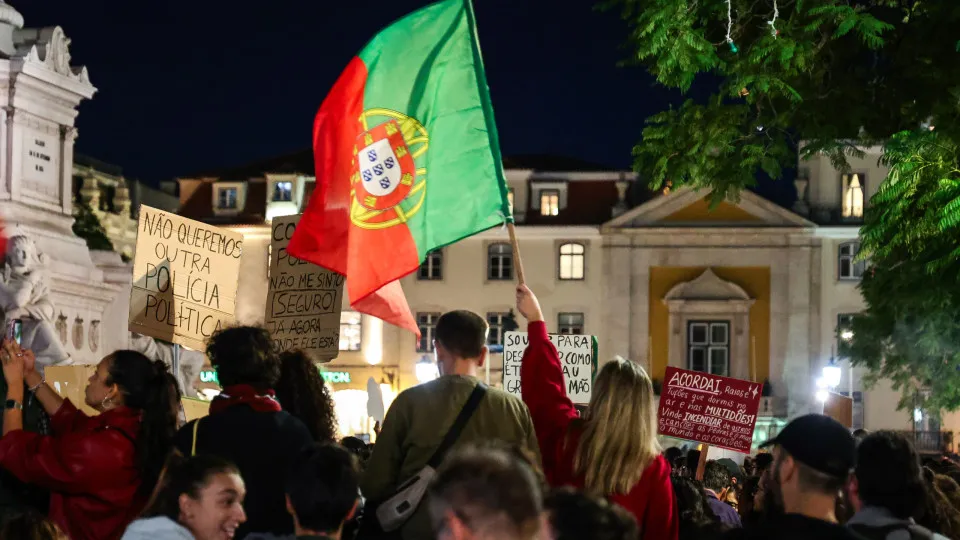
Constitutionalists Jorge Reis Novais and Teresa Violante accused the government of violating the right to protest for housing, considering the interpretation of the law of 1974 as abusive.
© Getty Images
26/10/2026
by
Lusa
Othe constitutionalists Jorge Reis Novais and Teresa Violante today considered that the right to the demonstration has been “violated ostensibly” in protests for housing, accusing the government of an abusive interpretation of the 1974 diploma.
In statements to the Lusa agency, Jorge Reis Novais argued that the right to demonstrate, provided for in Article 45 of the Constitution of the Republic, “has been violated in an ostensibly way through police interventions” that took place this weekend in Lisbon and Porto.
Police action on the “campadas” – term used by protesters to define the set of tents mounted in the public space – has been framed by the Public Security Police (PSP) in Decree-Law No 406/74, which regulates the exercise of the right of meeting and demonstration in public places, limiting it from midnight to midnight.
Today, the Attorney General of the Republic (PGR), Amadeu Guerra, challenged the parliament to revise this diploma, rejecting the review of this decree-law to the Constitutional Court (TC). The President of Parliament, José Pedro Aguiar-White, argued that it is up to the TC to determine whether the law of the right of demonstration “is or is not” constitutional.
Jorge Reis Novais rejected the need for amendments to the 1974 law and imposed responsibilities on the Government: “This law has been in force for dozens of years and there was never a problem. The problem is how the government, the Minister of the Interior, the Prime Minister and the police interpret what is in the law.”.
The constitutionalist pointed out that the time limit entered in the diploma aims to ensure “the peace of the other citizens”. However, if a manifestation or vigil occurs in silence, “it is obvious that, despite what the law says, one is in the exercise of the right of manifestation”.
“ When citizens manifest themselves, without disturbing others, without attacking them, peacefully, they are exercising the fundamental right to demonstration. And the exercise of a fundamental right, even if it contradicts what is laid down in the law, cannot be attacked to the batonada ", criticized.
Jorge Reis Novais argued that “any lawyer in a half bowl” knows that “the letter of the law has to be interpreted”, considering that it is a question of an abusive reading of the diploma.
“Imagine what it would be if, for every illegality that the Minister of Internal Administration has committed in recent years, or that the Prime Minister has committed, they were attacked to batonada, in which state they would not be sad today,” he ironic.
Along the same lines, constitutionalist Teresa Violante considered that security forces seem to be being instructed to treat these protests “in a strict manner, which was not applied previously”, indications originating in the government, not justified.
“ Until this is done, it seems to me that we can only conclude that what is being done here is violations, I would say, gross of the right of demonstration”, he argued.
Despite considering that the 1974 law “is bad and inappropriate”, Teresa Violante pointed out that she “had served”, with some difficulties, and rejected “hot” legislative moves that could even lead to restrictions on the current constitutional framework.
“ This is not so much a problem of a possible unconstitutionality of the law as it is, but of the interpretation of the law that is being forced”, he stressed.
Jorge Reis Novais, who was a consultant for constitutional matters of the President of the Republic Jorge Sampaio (1996-2006), also argued that the head of state, António José Seguro, should have pronounced on this issue by considering that it is a “obstensive aggression of a fundamental right”.
Regarding the use of tents in the public space, both constitutionalists considered that it is closely linked to the essential object of protest, symbolizing the lack of a house. For this reason, it is not a question, in your opinion, of the application of rules concerning a camp, but rather of a “form of exercising the right of demonstration”.
At this point, the constitutionalist Vital Moreira disagrees. Contacted by Lusa, he referred an opinion on the subject to his blog “Cousa Nossa”, in which he argued, on 22 October, that the “camped” are “ilicit” and considered justified the police intervention to put an end to them, “necessarily saved proportionality in the means”.