
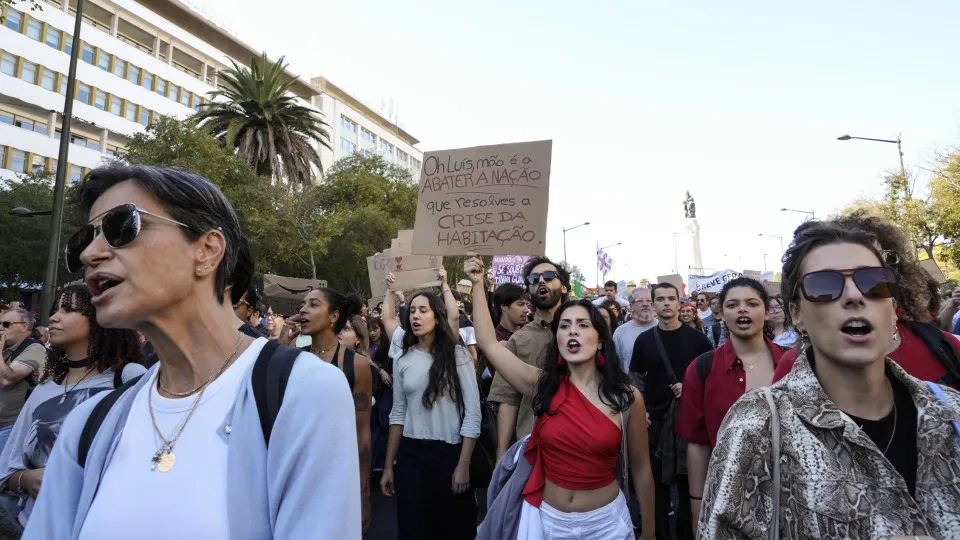
The subpoena for the protection of rights, freedoms and guarantees presented to the Lisbon Administrative Court in the context of the camps imposed restraint on the authorities while the process was proceeding, according to two legal experts.
© Horacio Villalobos#Corbis/Getty Images
26/10/2026
by
Lusa
A subpoena for protection of rights, freedoms and guarantees presented to the Administrative Court of Lisbon in the context of camp, although it does not suspend the powers of police, imposed restraint while the process takes place, consider two jurists.
Renata Cambra, one of the protesters of the Lisbon Camp, presented on Tuesday a subpoena for the protection of rights, freedoms and guarantees, an urgent procedural mechanism used when one considers that some of the fundamental rights are threatened by the State to ask a court to arbitrate the conflict.
Following the initiatives to protest for the housing crisis, there are already public differences between lawyers and police authorities, supported by the Government, on the law that applies: if Article 45 of the Constitution of the Portuguese Republic, which enshrines the right of assembly and demonstration, if Decree-Law No 406/74, which regulates the exercise of the right of assembly and demonstration in public places.
The subpoena – drafted by the lawyer Leonor Caldeira – was admitted by the court on Thursday, with the response time of the parties invoked.
“The presentation of a subpoena for the protection of rights, freedoms and guarantees does not suspend, by itself, the powers of action of the police authorities,” said Luisa Finisho, a lawyer specializing in criminal law and doctoral in human rights, with extensive experience of defense in the context of public demonstrations and protests.
However, “the MAI [Ministry of the Internal Administration] and the municipality of Lisbon were notified of the existence of the process and were aware that the legality of police interventions was pending judicial review”, a circumstance that “imposed, at least, a special prudence and restraint in the actions of the authorities”.
“Instead,” was ordered “a disproportionate police operation, from which they were injured,” he criticizes.
The government “is not obliged” to refrain from acting as it understands as the process of subpoenaing takes place, but “surely” that should have done so, “even because there are founded doubts about the constitutionality of the limitation to the right of manifestation” that is being applied, agrees Francisco Pereira Coutinho, professor of the NOVA School of Law and specialist in International Public Law and European Constitutional Law.
The subpoena to the court “is very important”, stresses, recognizing that legal clarification about the exercise of the right of demonstration is necessary, which “is being restricted as never before”.
“ We have here a problem that is an interpretation of the very literal and incongruous law with situations of the past ", notes the jurist, referring to the difference in the treatment of police against other camped out (case of the JSD initiative at the door of the Ministry of Higher Education, in 2020, or the protest of firefighters in front of the City Hall of Porto, in 2024).
However, a legal pronouncement “delays” and “it is not reasonable to expect the government to be paralyzed”, grants, urging the Assembly of the Republic to act: “It is Parliament’s fault and not the government’s fault, because it is the one who has the power to amend laws and the law needs to be reviewed.”
Analyzing the concrete case of the Camps of Lisbon and Porto – already twice the target of police interventions that forced the dispersion of protesters and the dismantling of tents in public squares, resulting in several injuries and arrests –, Luísa Finished focuses the discussion on the use of tents and the time limits, which the police have used to justify their performance.
The time limit “cannot function as an automatic basis for the dispersion of a peaceful demonstration”, points out, relying on international jurisprudence.
In Portuguese camps, “security forces have issued dispersal orders on the basis of the 00:30 time limit, provided for in Decree-Law No 406/74”, a provision that “does not apply to demonstrations”, he says, explaining that the article in question refers to “meetings of other gatherings”, a figure distinct from demonstrations and parades, identified in other provisions.
And even if it covered them, as the decree-law is before the Constitution, it could only be applied if compatible with the protection of the right of manifestation: “The authorities must demonstrate in each specific case that the restriction is necessary to protect other legitimate rights or interests and that there are no less restrictive measures capable of achieving that objective.”
According to the jurist, the mandatory cessation of all demonstrations at 00:30, “regardless of their nature, location or actual impact on third parties, is not compatible with constitutional and international requirements”, so “peaceful demonstrations should, as a rule, be able to end on the initiative of the participants themselves”, since “the time and duration of a protest may be essential to achieve their objectives”.
Francisco Pereira Coutinho also questions the application of the time limit in question. “The country has agreed to a standard that has never been applied until now,” he points out, questioning: “If midnight and a half is the limit for ending, is there a rule about when you can start? Is it the next minute?”.
Also the question of the form “is not irrelevant”, given its symbolism: “It is important to clarify the weighting between the general interest of not occupying the public space with tents and the individual right to manifest with tents.”
In a 2016 judgment, the European Court of Human Rights, appreciating a demonstration that intended to set up tents in a Moscow square, Russian capital, judged that “temporary facilities may, in certain circumstances, constitute a form of political expression,” exemplifies Luisa Finished.
“ In a protest for the right to housing, the installation of tents has a particularly evident meaning” and “reducing these tents to their administrative classification, treating them as simple camping equipment subject to licensing, means ignoring their political and expressive function”, notes.
Recognizing the special urgency of the situation, the Lisbon Administrative Court set 48 hours the deadline for the defendants, MAI and Câmara Municipal de Lisboa (CML), to pronounce on the subpoena filed by Renata Cambra.
According to attorney Leonor Caldeira, MAI has already sent a response to the court, but CML has not yet.
In response to Lusa, the municipality led by Carlos Coins claimed to have received the subpoena “today mid-morning” (by mail, but the court’s email was sent on Thursday, according to the lawyer) and that the deadline for reply only counts from there.
In any case, Pereira Coutinho recalls that the first instance decision will be subject to appeal, which will prolong in time the divergent understanding of the laws to apply to the ongoing demonstrations, which have mobilized thousands of people.