
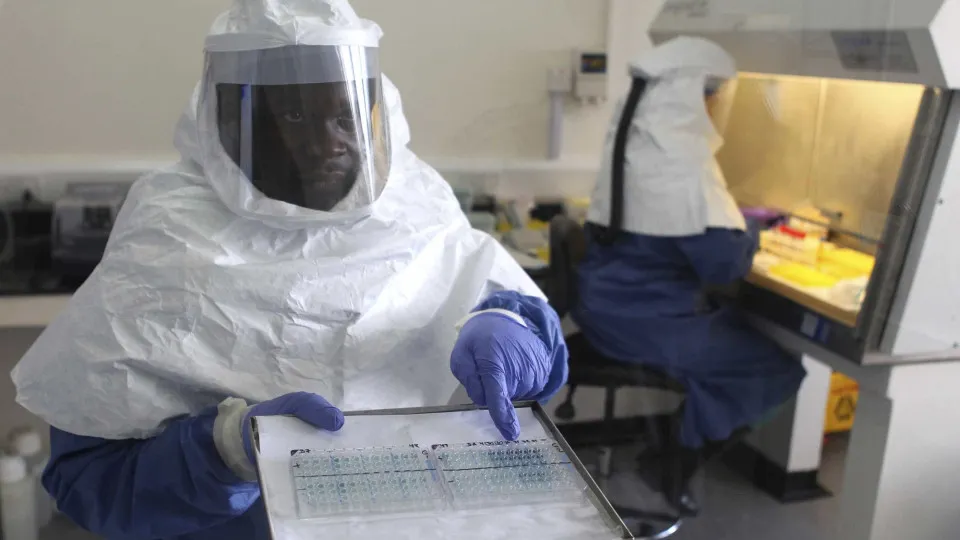
Health experts warned Lusa that the skepticism of the local population and the history of violence in the eastern Democratic Republic of Congo make it difficult to respond to Ebola, where the epidemic progresses “in the shadow” of official statistics.
© Reuters
25/10/2026
by
Lusa
ANDhealth specialists warned Lusa that the skepticism of the local population and the history of violence in the east of the Democratic Republic of Congo hinder the response to Ebola, where the epidemic progresses “in the shadow” of official statistics.
According to the Regional Director of the World Health Organization (WHO) for Africa, Mohamed Yakub Janabi, in an interview with Lusa, the Democratic Republic of Congo (DRCongo) reported, on October 20, 9,704 confirmed cases and 4,687 deaths, which translates into a mortality rate of 48.3%.
However, the perception on the ground is that the actual numbers are substantially higher.
Tomás Bandeira, head of tropical medicine of the organization Médicos Sem Fronteiras (MSF), warned, in a telephone interview to Lusa, that the available data must fall short of the real ones and thus the disease spreads “in the shade” and the problem “is far from being solved”.
“ We are witnessing many cases that do not even arrive in time for treatment, places where we ourselves cannot reach, or because the communities do not accept us, or because the security conditions do not allow us to arrive”, said the MSF's manager, from Mongbwalu, a city rich in gold where the epidemic began and was declared.
The Portuguese doctor explained that the local population, without a history of the presence of humanitarian organizations and accustomed to contact mainly with foreigners linked to mining or using traditional methods of treatment, looked at international teams with distrust.
To respond to the lack of confidence, which even led to attacks against treatment centers – such as those registered in Nyankunde in July – the WHO and its partners reinforced their work with community leaders, religious, traditional medicine practitioners, survivors and local health agents, Mohamed Yakub Janabi explained.
“ In Nyankunde, 32 dialogues were promoted with more than 1,500 leaders and influential figures. The initiative raised the daily community alerts from a maximum of 11 to between 60 and 70 in September, without registration of new attacks on the site since July ", indicated the regional director.
Also in Mongbwalu, almost six months after the arrival of the MSF, work with local authorities and community leaders also allowed the treatment centre to cease to be viewed as odd, with the population returning to the hospital.
Ebola is highly contagious and is transmitted through direct contact with the body fluids of an infected person, including blood and vomiting, or through contact with contaminated materials and surfaces such as linen and clothing.
The epidemic, caused by the Bundibugyo virus – on which clinical uncertainties still remain due to the scarcity of comparative data – is classified by Tomás Bandeira as “a crisis within a crisis”.
The doctor recalled that the epidemic in this country, neighbor of Angola, develops in a scenario of armed conflict, with the presence of multiple paramilitary groups, where there is a high level of displacement of populations and simultaneous outbreaks of cholera and malaria.
While Ebola requires reliable access to patients and tracking contacts, cholera requires clean water, sanitation and targeted vaccination, the WHO leader was warned.
In addition, the absolute focus on Ebola is diverting attention and resources from vaccination campaigns and the fight against other highly lethal diseases, such as malaria, the Portuguese doctor reflected.
To stop the chain of transmission, the WHO regional director defended as immediate needs safe humanitarian access, predictable financing, support and reliable payment to frontline workers and appropriate goods and materials.