
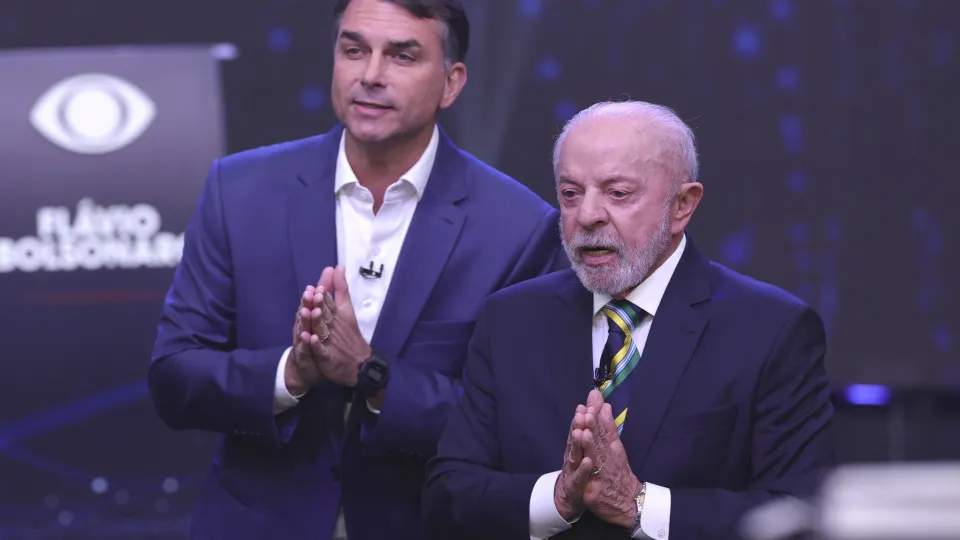
Brazil decides, on Sunday, who will be the next President of the largest Portuguese-speaking country and Latin America, in a struggle between the current head of state, Lula da Silva, and Senator Flávio Bolsonaro, Jair's eldest son.
© Lusa
23/10/2026
by
Lusa
O Brazil decides, on Sunday, who will be the next President of the largest Portuguese-speaking country and Latin America, in a struggle between the current head of state, Lula da Silva, and Senator Flávio Bolsonaro, Jair's eldest son.
Both they're technically tied in the polls, one image of a country divided in half.
Bolsonaro's son made it on the first lap on October 4, an advantage of two percentage points on Lula da Silva and profile as a favorite in the final line of the campaign for the october 25 elections.
Chosen as a candidate by the father, who is serving in house arrest a 27-year sentence for leading a coup attempt to overthrow Lula after losing the elections of 2022, Flávio tin public security, reducing the weight of the state and in an economy of liberal orientation the main flags.
Under the motto “Brazil Without Fear”, defends the reduction of the age of criminal responsibility for the 14 years in certain crimes, the adoption of the prison model of the President of El Salvador, Nayib Bubble, and the strengthening of the fight against drug trafficking and the main criminal organizations of the country.
No economic and administrative plan, aims to significantly reduce the structure of the State, including the elimination of at least ten ministries and the reduction of political confidence and public expenditure positions.
Promise still lower taxes, privatize public companies and adopt measures to achieve fiscal balance, reduce debt and lower the cost of living.
Lula da Silva, 80, if he wins, renews his mandate and completes the four years of government, will be the second President who longest ruled Brazil, 16 years old, and also the oldest.
Born in the Northeast of Pernambuco, he moved as a child to the suburbs of São Paulo, where he began to work as a mechanic before becoming one of the leading union leaders in the military dictatorship.
In 2003, after losing the presidential elections of 1989, 1994 and 1998, Lula da Silva became President of Brazil.
In 2018, the Workers' Party (PT) came to officialize its candidacy, at the time it was arrested due to the Lava Jato case, but was prevented by the Electoral Justice. Fernando Hadadd ran and lost against Jair Bolsonaro.
At the launch of his campaign in August, he filled with supporters the stadium where he led the strikes of the 1980s, in an emotional homage to the union struggle and himself.
Social policy marked its three presidential mandates, especially the Bolsa Família, which helped to remove millions of Brazilians from poverty.
Now he calls on you this legacy and adds another fight: prevent the return of the extreme right, whose latest reincarnation is Flávio Bolsonaro, son of former President Jair Bolsonaro, who lost the Presidency in 2022 to Lula.
It will be in these two political projects that more than 158.7 million voters will be able to vote on Sunday at the 563.910 electronic ballot boxes spread across 5,571 cities in the country, as well as 186 cities abroad, such as Lisbon, Porto and Faro.
Lula da Silva's campaign in the second round was marked by a strong mobilization on social networks, streets, demonstrations called by artists and initiatives of students and social movements to win votes and combat abstention.
After the disadvantage in the first round, he bet on defending democracy and its social legacy, intensified attacks on the opponent and announced economic and labour measures to seek to reverse the outcome.
Flávio Bolsonaro combined demonstrations of strength in the streets, with a bet on social networks, mobilizing digital influencers and figures such as Mr Nikolas Ferreira to expand the reach of the campaign.
He also obtained the support of defeated candidates in the first round, such as Ronaldo Caiado, Romeo Zema and Augusto Cury, who added 5.34% of the valid votes, as well as former President Michel Temer and the country's main central parties.
The dispute extended to digital platforms, with Lula's campaign accusing the Meta, owner of Facebook, Instagram and WhatsApp, of favoring Flávio Bolsonaro and resorting to the Superior Electoral Court to require equal treatment between applications, denouncing accounting restrictions, removing content and failures in artificial intelligence tools.
The two held the first debate last Sunday and will now face up tonight in the second and final debate of TV Globo.
On Saturday, the eve of the vote, Lula da Silva plans to close the campaign with shares in Rio de Janeiro and São Paulo, while Flávio Bolsonaro must pass through Belo Horizonte before finishing the day with a caravan car in Rio de Janeiro.