
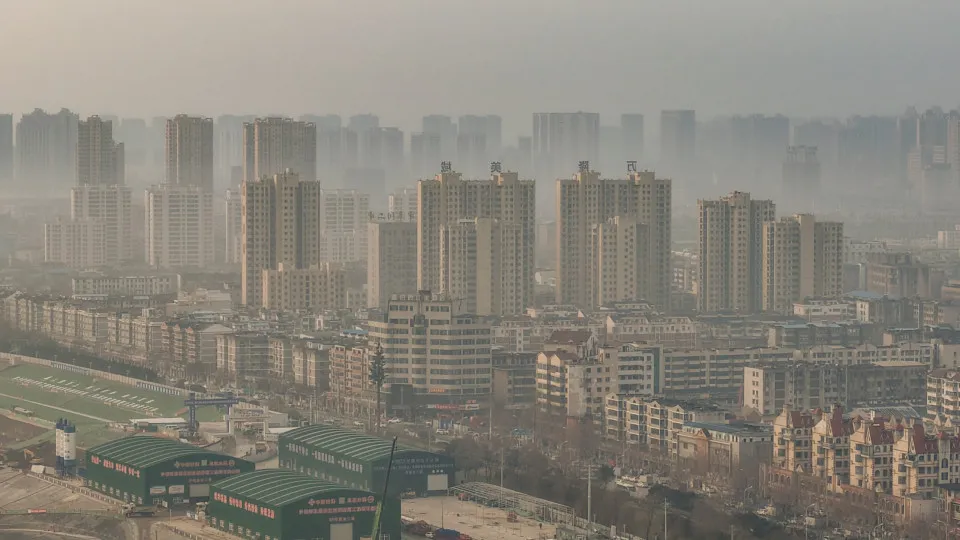
The levels of air pollutants in the Pearl River Delta in southern China, including Hong Kong and Macao, have fallen between 23% and 86% in the last 20 years, according to a report published today on the region.
© Sheldon Cooper/SOPA Images/LightRocket via Getty Images
23/10/2026
by
Lusa
Olevels of air pollutants in the Pearl River Delta in southern China, including Hong Kong and Macao, have fallen between 23% and 86% in the last 20 years, according to a report published today on the region.
The Chinese Air Quality Monitoring Network shows that in 2025 the levels of all types of air pollutants – sulphur dioxide, nitrogen dioxide, carbon monoxide, inhalable particles and fine particles – “all of them presented a continuous downward trend”.
Among these values, we highlight the concentrations of fine particles, which lowered to “a level that is among the best in the country”.
“ This shows that the emission reduction measures implemented by Guangdong, Hong Kong and Macao in recent years have been effective in improving air quality in the Pearl River Delta Region,” Macau’s Environmental Protection Services (DSPA) Directorate said in the communication.
DSPA added that over the years the Guangdong, Hong Kong and Macao Governments have been launching various policies and measures to improve air quality in the region.
In Macao, measures have been introduced to improve air quality, such as the elimination of highly polluting vehicles, the promotion of electric vehicles and the control of vehicle exhaust emissions.
In 2025, the government restricted the limit values of certain parameters for unleaded petrol.
On Thursday, the Executive Board announced even greater restrictions on emission limit values for motorcycles and mopeds and diesel cars in circulation, which will enter into force on January 1, 2028.
DSPA stated that it is exploiting the potential for the application of photovoltaic resources in public spaces and optimizing the proportion of clean electricity in the energy structure, to “control the emission of local air pollutants and improve air quality”.
In Hong Kong, in May 2025, the Government again restricted the permitted limits of emissions of air pollutants from the electricity sector, to the extent that it will enter into force from 2030.
Compared to 2010, the maximum emission limits for sulphur dioxide, nitrogen oxides and inhalable particles from power plants were reduced by 91%, 80% and 75% respectively.
Furthermore, the Hong Kong Government plans to phase out some 40,000 older diesel commercial vehicles by the end of 2027.
“ By the end of August 2026, more than 33,700 targeted vehicles had been slaughtered,” according to the report.
Hong Kong also plans to suspend the new records of private vehicles powered by fossil and hybrid fuels by 2035, to put in circulation by the end of 2027, about 700 electric buses and about 3,000 electric taxis, to achieve zero emissions of gaseous pollutants by 2050.
With regard to vessels, in 2019, Hong Kong, in collaboration with the cities of the Greater Bay, “has established, in the maritime areas of the Pearl River Delta”, an air pollutant emission control zone from vessels, “stimulating that all vessels” that sail or land in the maritime areas of Hong Kong “have to use fuels that meet the standards”.
After the implementation of the measure, the station near the Kwai Chung Marine Container Terminal recorded a “in 2025 a 50% reduction in annual sulphur dioxide concentrations compared to 2018, which shows that the control measure was effective”.