
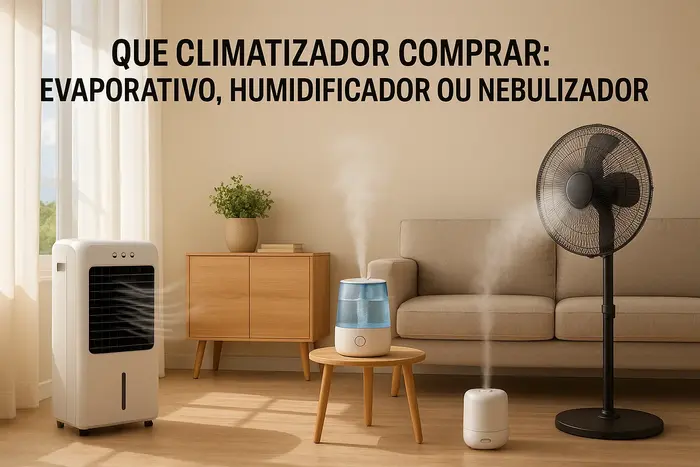
With climate variations and demand for thermal comfort and air quality, many consumers wonder which device is best suited for their needs: a evaporative air conditioner, one humidifier or one nebulizer fan. Although similar, they are different devices and for different uses. Let's explain how each one works and what its advantages and disadvantages.
Evaporative Clamp
What is it?
O evaporative air conditioner uses the principle of evaporation of water to cool and humidify air simultaneously. The device pulls the warm air from the environment and makes it pass through a damp filter, where the water evaporates by consuming heat from the air. This colder, damper air is blown into the environment, generating a more comfortable thermal sensation.
It is the best option for hot and dry environments as it cools the relative humidity of the air.
Advantages
- Air cooling: It effectively reduces the temperature of the air entering the environment.
- Humidification: Adds moisture to the air, which is useful in dry climates.
- Ventilation: It circulates the air, improving the feeling of freshness.
- Low energy consumption: Compared to air conditioning, it has less energy expenditure.
Disadvantages
- Limited effectiveness in humid climates: When air humidity is high, evaporation decreases and cooling loses effect.
- Size and noise: They're usually bigger and louder than humidifiers.
Recommended Use
Ideal for hot and dry environments, such as semi-arid climate regions, and for those who want a device that refreshes and humidifies at the same time.
Humidifier
What is it?
The main function of the humidifier is to increase air humidity without significantly altering room temperature. There are ultrasonic models that generate a fine mist (vapor) to correct dry air.
Advantages
- Improves air humidity: Ideal for dry climates or environments with air conditioning and heating.
- Silent operation: Ultrasonic appliances are very quiet, suitable for rooms and offices.
- Precise control: Many models have humidity sensors and automatic shutdown.
- Compact size: Easy to transport and install in any room.
Disadvantages
- Do not cool the environment: The fog doesn't reduce the air temperature.
- Slow Evaporation: Moisture is gradually released and may not be enough for large environments.
- Careful maintenance: It requires regular cleaning to prevent bacterial proliferation.
Recommended Use
Suitable for those who want to combat dry air, especially in indoor environments, with air conditioning or heating, and for use in rooms of children or people with respiratory problems.
Miscellaneous fan
What is it?
The nebulizer fan combines a fan with a system that sprays water into ultrafine drops in front of the air outlet. These droplets evaporate rapidly as they come into contact with the skin, generating a refreshing local sensation.
Advantages
- Feeling fast: Ideal for cooling people directly.
- Low consumption and portability: More compact and with less energy expenditure.
- Silent: Works with low noise, suitable for personal use.
- Simple to use: Just fill it with water and turn it on.
Disadvantages
- Do not cool ambient air: The ambient temperature hardly changes.
- Effect limited to fog range: It works best for those close to the device.
- It does not significantly humidify the environment: The mist evaporates rapidly and does not alter the overall humidity.
Recommended Use
Ideal for personal use, in open areas or well ventilated environments, and for those who seek to refresh themselves quickly without the need to cool the whole environment.
Why only does the evaporator cool the air?
The main difference between an evaporator air conditioner and a humidifier or nebuliser fan is the fact that only the first air cools. This is because this device releases water in the form of steam. In other words, evaporation is done inside the device, while in the rest it happens outside the device. Thus, the air comes fresher (typically between 2 to 5 degrees Celsius).
A humidifier or nebulizer fan releases small droplets of water, and it will only evaporate at a later stage. However, the air conditioner will release air below the ambient temperature.
Comparative Summary
But see the following summary table with more information.
| Evaporative Clamp | Piezoelectric humidifier | Miscellaneous fan | |
|---|---|---|---|
| Operating mode | Evaporation of water in damp filter, cools and humidifies the breathed air | Ultrafine mist generated by piezoelectric vibration, only humidifies | Ultrafine mist sprayed in front of the fan, refreshes the skin |
| Water released in the air | Water evaporates inside the apparatus, humidifying the environment | Ultrafine mist released into the air, increases humidity without changing temperature | Liquid mist comes out in the air and evaporates in the skin, increasing freshness |
| Effect on temperature | Cools the air effectively, reducing room temperature | Do not cool the environment; virtually stable temperature | Do not cool the ambient air, cool the skin by contacting the evaporating mist |
| Area of action | Small to medium environments | Small environments or places close to the device | Limited area, personnel or small groups close to the apparatus |
| Energy consumption | Moderate (ventilator + water pump) | Low (ultrassonic) | Low (ventilator + ultrasonic nebuliser) |
| Noise level | Medium due to fan and pump | Very quiet | Low, practically just the fan |
| Maintainer | Periodic change/cleaning of filters and water reservoir | Regular cleaning to avoid bacteria and minerals | Tank and nebuliser cleaning |
| Ideal for | Hot and dry climates for cooling and humidifying environments | Dry environments, rooms, night use, to correct low humidity | Cool people directly in open or ventilated environments |
| Disadvantages | Lower efficiency in humid climates, higher noise and size | Do not cool, slow humidification for large environments | Do not cool the environment, limited effect to near reach |
Conclusion
Each device has its own function and benefits.
O evaporative air conditioner is the most suitable for those who want to cool and humidify small to medium environments in dry climates.
The humidifier is the best to increase air humidity in closed and dry places, without changing the temperature, being ideal for residential use.
Finally, the nebulizer fan is perfect for cooling people individually, providing rapid heat relief, but without cooling the environment.
When choosing, consider your local climate, the size of the environment, the purpose (cool, humidify or both) and aspects such as noise and maintenance. So you will make the best choice for your comfort and health.