
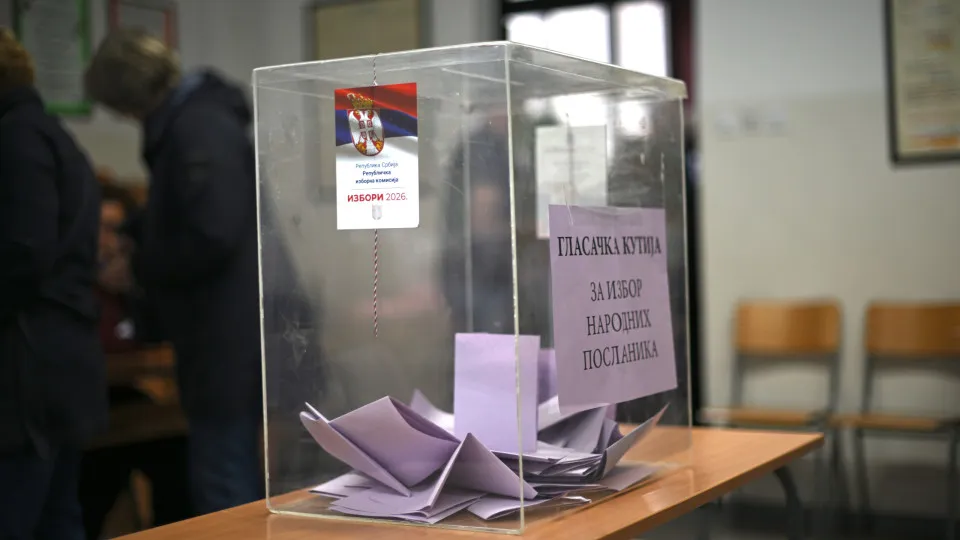
The parliamentary elections in Serbia are underway, with populist leader Aleksandar Vucic facing a movement of students who led protests against him for two years.
© Getty Images
25/10/2026
by
Lusa
Athe polls opened today in Serbia for the legislative elections, considered a confrontation between the Balkan populist leader Aleksandar Vucic and a movement of university students who led protests against him for almost two years.
At the beginning of the morning, voters lined up at the polling venues across the country, something that Ilija Srdanovic, a doctor who is the first of the 250 candidates of the youth movement, said was the forerunner of “a record turnout in Serbia’s recent history”.
“ I hope that this day will take place in a democratic and peaceful environment and that we will legitimately choose a new government in Serbia,” Srdanovic said after voting in the city of Novi Sad in northern Serbia.
Vucic’s opponents, as well as some independent observation groups, warned of possible irregularities in the electoral process.
Although Aleksandar Vucic claimed that he would recognize defeat if he lost the vote, he also warned that any protests that could erupt claiming fraud in the event of his party's triumph would be immediately repressed.
Although the 6.4 million voters of Serbia can choose from 18 parties who aspire to enter Parliament, composed of 250 members, the election took the form of a referendum between the right-wing Serbian Progressive Party of Vucic and the Youth-backed Student List.
It is believed that the main candidates are tied in polls, making today's election the most uncertain of recent years. It is hoped that the turnout at the polls will be high and will be able to push most smaller parties below the 3% threshold needed to enter the assembly.
Although Vucic has in the past systematically overcome Serbia's fragmented opposition, the youth movement without a leader has proved to be a difficult adversary who has shaken its firm grip on power in Serbia as no one else has achieved in the last 14 years since its party took power.
A student victory would likely have repercussions beyond Serbia, at a time when countries across Europe face protests from young people and students.
Recent elections have been marked by irregularities and the European Union is therefore closely monitoring the progress of today's vote in a country which is a candidate for membership of the European bloc.
Both international and local election observers have already expressed concern about the security and impartiality of an electoral campaign marked by arrests, almost total government control of the media, surveillance reports and cyber attacks against activists.
Local elections held earlier this year in 10 municipalities in Serbia were the scene of violent attacks against journalists and activists. The previous parliamentary vote in 2023 was followed by opposition protests alleging fraud.
If his party, the SNS, gets the majority of the votes, Vucic will become Prime Minister after having served two almost complete mandates as President. He resigned last month to lead the campaign.
The popularity of populists has been decreasing since 16 people died two years ago, when concrete cover collapsed at a railway station in northern Serbia, triggering a wave of youth protests demanding accountability for disaster and justice for victims.
The indignation reflected widespread accusations of high-level corruption and nepotism, with protesters claiming that rampant corruption led to negligence during renovation works at Novi Sad station and the consequent collapse of coverage.
Despite the protests, Vucic maintains considerable support among Serbian voters. His admirers see him as a leader capable of leading the nation through global uncertainties — an image that was carefully constructed by the traditional media.
In turn, the recently formed Student List movement differs from any other political organization in Serbia. It consists of university students, but none of them are actually on the list. Instead, candidates are little known experts, sportsmen, farmers and artists.
This approach aimed to counter the unipersonal government of Vucic and restore a sense of community and solidarity. The message “We know how” during the campaign promised a party effort to rebuild Serbia’s economy and democracy after a change of government.
With their youthful energy, students attracted disillusioned voters with local politicians. Defamed by the pro-government media, students traveled the country by bicycle and on foot to reach the voters of rural areas — the traditional Vucic bastions.
The state electoral committee is not expected to release the official count before Monday.