
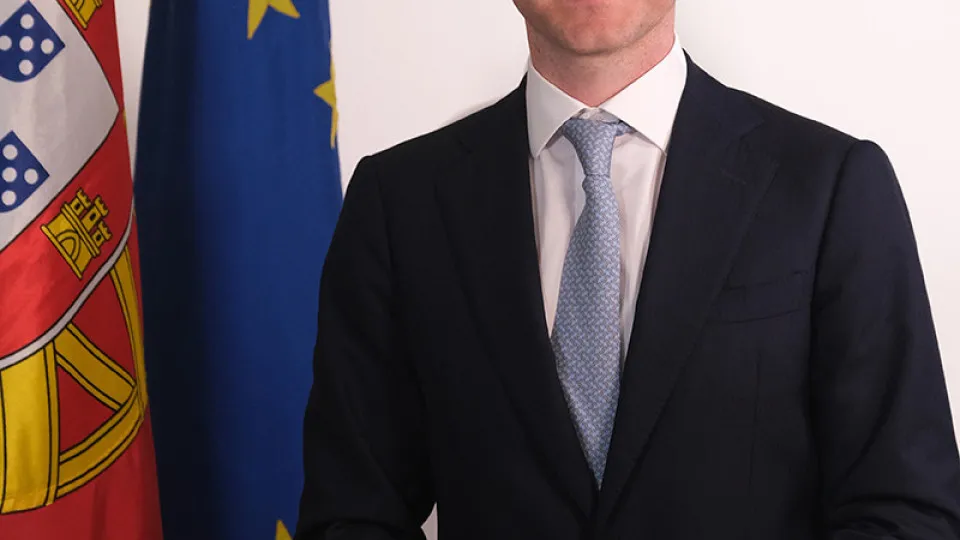
The Deputy Secretary of State of the Presidency and of Immigration, Rui Armindo Freitas, today accused the PS of putting himself on the edge of the “field of moderation” and of remaining “a denialist of uncontrolled immigration”.
© Website/ Government
25/10/2026
by
Lusa
Rui Armindo Freitas
O deputy Secretary of State of the Presidency and Immigration, Rui Armindo Freitas, today accused the PS of putting themselves on the edge of the “field of moderation” and of remaining “negationist of uncontrolled immigration”.
In an interview with the agency Lusa, on the occasion of the three years of the creation of the Agency for Integration, Migration and Asylum (AIMA), Rui Armindo Freitas recognized that the Aquida made more legal changes possible than the PS, but stressed that the government itself led all processes.
“ The government is the leader of the government’s agenda and this is so that the immigration proposals taken [and approved] to the Assembly of the Republic were always from our initiative, or from the PSD or CDS parliamentary groups”, fulfilling the most detailed electoral program on the subject, said Rui Armindo Freitas.
“ Immigration must be discussed in the great space of moderation, precisely because of this, because it cannot have the laxity of certain political quadrants, nor the radicalization of anti-immigration of those who oppose it”, he said, stressing that in parliament, “the space of moderation” called for “the responsibility of the parties in the Assembly of the Republic and joined those who wanted to join”.
In most of the diplomas, “vote PSD, CDS and Liberal Initiative and in some things voted for Acheva and others abstained”, while the “Socialist Party abstained in some and voted against, because it remains the denialist of uncontrolled immigration that occurred in Portugal and that is in sight of everyone”.
Nevertheless, Rui Armindo Freitas considered that the “government did not use immigration to grow, to mark this or that political force”.
Today, in migration matters, “we are still a moderate country, because we were in time to act” in settling pending cases.
This “at a time when the ground was fertile for populism”, including the left, right, “ultra-right more populist”, the “extreme-left more radical”, or “a certain Socialist Party that also radicalized on this theme”, he accused.
Today, part of the PS seems “to understand what happened, but another still does not understand absolutely anything about the state in which he left us the country in 2024,” he said.
“Our vision from the first hour was that we needed an immigration management system”, because, “over many years and the result of various reasons, the reality is that immigration was not thought of in a structured way because there had never been such pressure in Portuguese society”.
Therefore, the government promoted changes to the law of foreigners – ended with the manifestation of interest or with the work search visas –, changed the rules of access to nationality – extending the time for the naturalization of foreigners –, created a unit of foreigners and borders in the PSP – recovering part of the functions of the extinct SEF – and tightened the rules of return – with longer periods of detention and shorter times of resources, with the elimination of some intermediate stages.
“ We wanted to set up a system that worked”, Rui Armindo Freitas justified, refusing that the new rules lead to “a closed-door policy”.
“ This government believes that we need immigration, but with clear rules”, that “not only serve our community, whom it receives”, but also “those who come in search of a better future and who are not delivered as they have long been to indignity”.
On the Action Plan for Migration, presented in June 2024, the ruler admitted that there are still issues to be concluded, because the document “was never designed to be implemented in two and a half years with an electoral act in the middle”, but 80% of the proposals are fulfilled.
One of the subjects that remains to be resolved is the visa for the capture of qualified people that requires a ordinance to define the professions or the type of qualifications, something that Rui Armindo Freitas has yet to do, but also because there are “other channels of access” for this type of immigrants.
Already on the return regulation, approved in September by the European Union, will require further changes in national legislation, with the “harmonization of some of the rules” for its adaptation.
“ Our way of working has always been to adapt Portuguese legislation to the European framework,” the Secretary of State explained.