
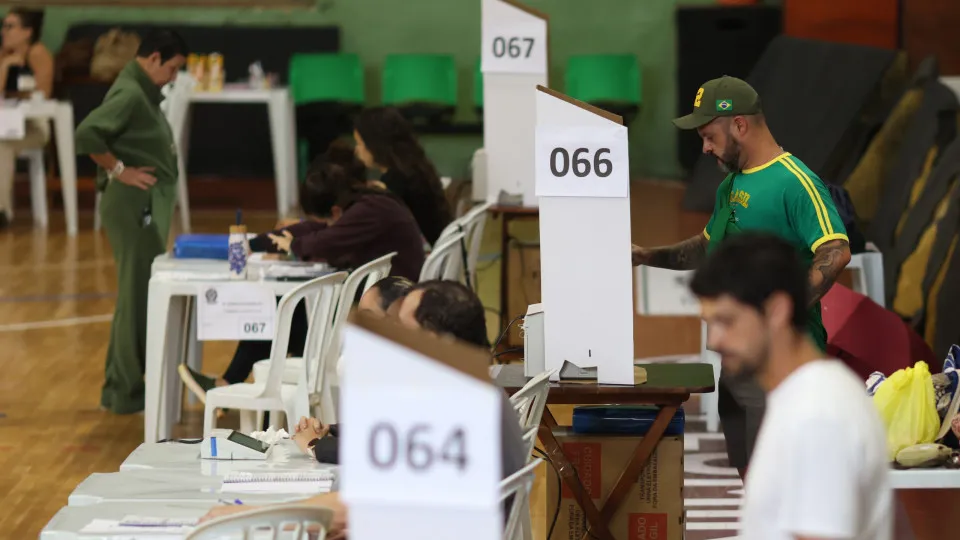
The governor of Bahia denounced obstacles to vote in the presidential election and made available police to drive buses in Salvador, after complaints of lack of transportation.
© Getty Images
25/10/2026
by
Lusa
O governor of Bahia denounced an attempt to prevent the population from voting today in the second round of brazilian presidential and made available police to drive buses in the capital, Salvador, after complaints of lack of transportation.
The intervention of the governor, the Workers' Party (PT), comes after the Brazilian Federation of Hope, which brings together the PT and other left-wing parties, denounced to the Electoral Justice a reduction of more than 50% of buses in circulation in the capital of Bahia.
“ As governor, I put the Military Police and the Public Security Secretariat at the disposal to identify police officers with a qualification D, able to drive the buses [buses], if necessary ", said Governor Jerónimo Rodrigues, on social networks.
TRE-BA determined that the City of Salvador and bus companies put the entire fleet of the capital on the streets, under fine of R $ 1 million per hour in case of noncompliance. As governor, I put the Military Police and the Public Security Secretariat at the disposal to identify police officers with a qualification D, able to drive the buses if necessary. I will not accept what they are doing to the Bahian population, trying to prevent people from exercising their right to vote. Let's make sure the people are able to vote!
— Jerome Rodrigues (@Jeronimoba13) October 25, 2026
“ I will not accept what they are doing to the Bahian population, trying to prevent people from exercising their right to vote. We will ensure that the people are able to vote!”, he added.
The City Hall of Salvador, equivalent to the City Hall in Portugal, is led by Bruno Reis, from the Brazilian Union, who declared support to Flávio Bolsonaro in this second round.
The Bahia Regional Electoral Court (TRE-BA) determined a short time after the complaint, the immediate restoration of the entire fleet and fixed a fine of one million reais (179,000 euros) per hour of non-compliance for the municipality and companies responsible for the service.
According to information from the Municipal Mobility Secretariat released by the g1 portal and reproduced by the local press, at least 75 buses were prevented from leaving the garages.
According to the Brazilian press, which supports the number, buses were held in garages in Salvador for the withdrawal of stickers to support Lula da Silva, number 13.
Bus detainment has provoked complaints from passengers at stops, terminals and social networks.
Bahia and the Northeast as a whole constitute traditional electoral bastions of Lula. In the first round, the President obtained 5.66 million votes in Bahia, against 2.44 million Flavio Bolsonaro.
In the nine states of the Northeast, where he won in all, Lula added 21.49 million votes, against 10.40 million Flavio.
All the voting assemblies in the country opened at 08:00 in Brasilia (11:00 in Lisbon) and end at 17:00 (20:00 in Lisbon), keeping the unified hours adopted in 2022, despite the different Brazilian time zones.
More than 158.7 million voters will be able to vote until 17:00 in Brasilia (20:00 in Lisbon) in about 564,000 electronic ballot boxes spread across 5,571 cities in the country, as well as 186 cities abroad, such as Lisbon, Porto and Faro.
In the first round, Flávio Bolsonaro obtained 47.03% of the valid votes, against 45.16% of Lula da Silva, an advantage of 2.224,965 votes, and since the introduction of the system of two laps in Brazilian presidential, in 1989, no candidate who finished the first vote in second place managed to win the election.
The two are technically tied in the polls, portrait of a country divided in half.
Luiz Inacio Lula da Silva, from the Workers' Party, left, and former trade unionist, seeks reelection at the age of 80 and his fourth term, while Senator Flávio Bolsonaro, son of former President Jair Bolsonaro, from the Liberal Party and supported by the right, tries to return power to the Bolosnarist camp, four years after the father's defeat against the former worker who now tries to defeat.