
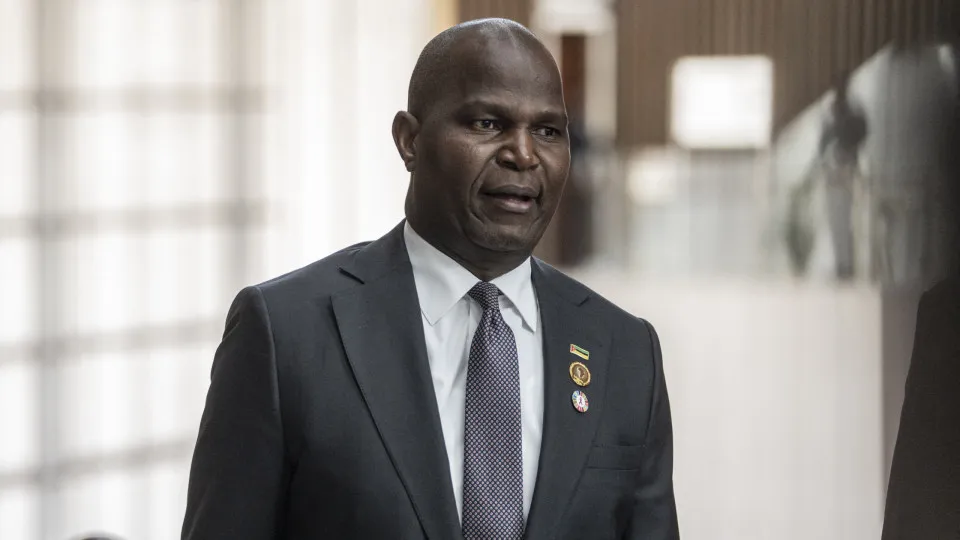
The Mozambican President today admitted in Ethiopia that terrorists continue to carry out sporadic attacks, saying that the greatest challenge is assistance to displaced people.
© Getty Images
24/10/2026
by
Lusa
O Mozambican President admitted today in Ethiopia that terrorists continue to carry out sporadic attacks, saying that the biggest challenge remains assistance to displaced people, and called for a commitment to multilateralism to stop this evil.
“ When terrorism began, he had occupied some villages in the northern district of Cabo Delgado. But because of these solutions, today the villages are free, but terrorists continue to make sporadic attacks and this causes displacement of the population,” said Mozambican state chief Daniel Chapo.
The President of the Republic spoke at the 12th Tana High Level Forum on Security in Africa, which runs from 23 to 25 October, in Bahir Dar, Democratic Federal Republic of Ethiopia, under the motto “Payways to Peace in Africa: Economic Sovereignty and Geopolitical Transformation”, bringing together Heads of State and Government, political decision-makers, academics and development partners.
“ The biggest challenge we have at the moment is to assist – humanitarian assistance to the people. The situation is relatively better than it was before. We remain alert to the attacks of terrorists, our armed forces, together with friendly forces from Rwanda, Tanzania and local forces, continue to fight terrorism,” Chapo said.
Since October 2017, Cabo Delgado has faced an armed insurgency associated with extremist groups linked to the Islamic State, a conflict that has already caused some 6,600 deaths and 1.2 million displaced people, according to international organizations.
In speaking at the event, Chapo said that Mozambique was supported from the outset by the Southern African Development Community Mission in Mozambique (SAMIM) and also by the Rwandan forces, which are now continuing in a model of bilateral cooperation in combating violent extremism. He also stressed that Tanzania's forces continue to guard the border with Mozambique to prevent the movement of terrorists in the context of bilateral agreements.
In this sense, he argued that security and peace are essential for the development of African countries in a sustainable way and thanked all countries that continue to support Mozambique in the fight against extremism.
“Our experience, one of the secrets of success in combating terrorism in Africa, is the union between African countries,” Chapo said.
“ A regional union of SADC, but we can also find African problems, African solutions, in this case a bilateral solution between Mozambique and Rwanda and then we also have a union between two countries, in this case Mozambique and Tanzania, that the Tanzanian forces along the Mozambique border continue to do a good job to block the entry of terrorists into Mozambique,” he added.
It defended multilateralism above all in the African Union, saying that it is time to find an African solution to terrorism.
Chapo once again called for representativeness to be reconsidered in the United Nations Security Council, criticizing that Africa has no members there, asking for reforms in that body.
“ And this reform of the United Nations Security Council must find room for Africa to sit and also have the right to veto. Because as long as we continue to talk about security in Africa, at the level of the United Nations Security Council, without a permanent member of the United Nations Security Council (...) it will be very difficult to resolve the issue of the security of the African continent,” he said.
Currently, some 1.38 million people continue to be affected by the conflict in Cabo Delgado, including approximately 662,000 internally displaced people and 722,000 inhabitants returning to their respective areas of origin, as reported by the United Nations.
“ Behind these numbers are families repeatedly forced to leave their homes, children whose education has been interrupted and communities whose livelihoods and access to basic services have been destroyed,” says a United Nations report.