
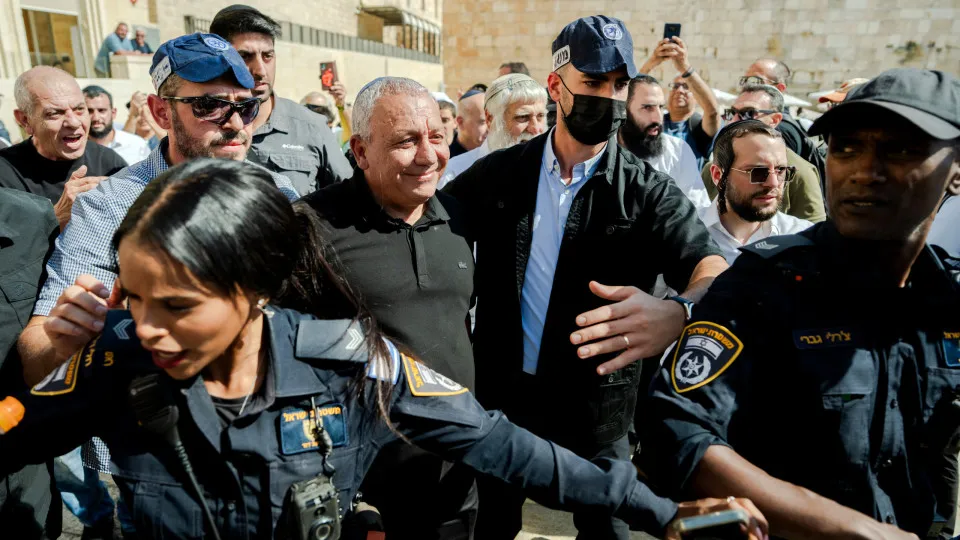
The Old City of Jerusalem is a mirror of the deep divisions in Israel before a highly uncertain election, between the support of the Prime Minister's policy of strength, Benjamin Netanyahu, and the change represented by the opponent Gadi Eisenkot.
© Erik Marmor/Getty Images
24/10/2026
by
Lusa
A Old City of Jerusalem is a mirror of the deep divisions in Israel before a highly uncertain election, between the support of the Prime Minister's policy of strength, Benjamin Netanyahu, and the change represented by the opponent Gadi Eisenkot.
When the last legislative polls of October 27 continue to identify a likely winner, the two main candidates share the problem of not gathering sufficient support, through post-election alliances with the pro-government forces or so-called block of change, to control the 120 seats of the Knesset (parliament).
Among vacancies of tourists and faithful who visit the sacred places of the main monotheistic religions, the election campaign is discreet within the walls of the Old Town, but not absent.
In the Jewish neighborhood, ultra-Orthodox parties display posters on the roofs and balconies, claiming the religious character of the state as a fundamental value, a theme that divides the lay Israelites, such as the end of the military exemption for the Haredim community, which represents 14% of the population.
Posters are also visible to ask that “make Jewish Palestine anew”, an unsigned adaptation of the United States’ MAGA movement, but that translates the thinking of far-right parties into the current government coalition, in particular the Otzma Yehudit, of National Security Minister Itamar Ben-Gvir, and the Religious Zionistmo, of his Finance colleague Bezalel Smotrich.
Playing at home in Jerusalem, ultranationalist supporters show up at the tram stations near Old Town and images of their leaders, dominated by the colors of the national flag, plus their radical agenda. A Ben-Gvir poster caused great controversy by presenting the politician and the phrase “Israel is strong”, but also two Palestinian prisoners kneeling and handcuffed.
The sacred enclosures were shaken by the echoes of news of the occupied territories, when two Israeli soldiers and two Palestinians were killed on Friday during a major operation in Hebron, in the south of the West Bank, including searches and demolition of buildings, justified to “locate and dismantle terrorist facilities” and lasting several days.
In the countdown to the decisive elections, in which he tries to counter unfavourable polls and conserve power, Netanyahu announced another large-scale operation in the West Bank, “as has not been seen since the Six-Day War”, in 1967, without needing dates but that “is on its way”, while Smotrich was calling for a military campaign in the territory “as in Gaza”.
The Prime Minister and leader of the Likud party, who has based his message on the protection of the Israelis and projection of the force of the country in the Middle East since the attacks led by Hamas on October 7, 2023, also warned its citizens to prepare for international sanctions, acknowledging the growing pressure of their main ally, the United States, due to violence in the West Bank.
The opposition, which rightly criticises the tension created with Washington, immediately directed a battery of criticisms to the Israeli leader, although generally none of its main leaders defend a breach in security policy.
On Thursday, Gadi Eisenkot, a former general who in 2025 founded the Yashar party! and in less than a year jumped to the top of the polls, visited the Wall of Lamentations, under high protection in a terrain more favorable to his opponent, and had a mixed reception, reflecting the deep division of the country.
“ Save us, we are waiting for you”, shouted supporters in the Old Town, while others sang “Bibi, king of Israel”, in reference to the nickname of the head of the government and his long journey in power.
Walking one of his three children on the narrow streets of the Jewish quarter on a late summer day, a voter would like to gather the best of both worlds.
“I would rather there was a change of government and that is what seems most likely. But I would like you to be as Zionist as possible, to seek also equality between Jews and Arabs and peace and security for all,” says the 37-year-old Israeli, who is just like Benny to the Lusa agency.
For this resident in the northern region, the memory of October 7 remains very present, in that “something very serious happened” that morning of 2023, which cost 1,200 dead and 251 hostages, “and many bad things continue to happen and demand responsibilities”, alluding to an independent investigation committee claimed by the opposition and so far refused by Netanyahu.
“ Responsibility and guilt are not exactly the same. Israel's Chief of Defense Forces has already resigned. So, this is the role of the Prime Minister ", observes.
On the other hand, Benny is faced with the dilemma facing some seven million voters, recognizing that the Israelis’ defense “is the government’s main competence” in the face of Hamas’ threats in the Gaza Strip and the Shia Hezbollah group in Lebanon, both supported by Iran, in opposition to the aspirations for peace.
“ These are military organizations that have sworn to commit themselves to killing my family and it seems reasonable to continue to attack them until they disarm. I sincerely pray that they will do so”, he adds.
Similarly, it has no “any problem” in accepting that Arab parties are part of a future government, at a time when polls indicate a post-election blockade that can be broken by the two Arab forces, the Joint List and Ra’am, representing 21% of the population.
However, and although I do not like the idea of exclusively Arab or Jewish parties, Benny highlights “important differences” between the two political groups, stating that some parties in the Joint List argue that “Israel should not exist and that is unacceptable”, while seeing in Ra’am a moderation that “is not a problem”.
As in so many places in the country, the Old Town Jaffa gate holds hundreds of images of former hostages from the Palestinian militias and soldiers lying in the Gaza Strip.
Just over a year ago, great demonstrations filled the Hostage Square in Tel Aviv to demand the ransom of the captive Israelites in the Palestinian enclave and the end of the war, as well as the residence of Netanyahu, ironically located on the street of Gaza in Jerusalem.
The ceasefire reached on 10 October 2025, which implied the exchange of the last hostages (20 alive and 28 killed) for nearly two thousand Palestinian prisoners, did not bring about the conflict and has since added about 1,400 dead, according to the authorities of the territory, to the more than 70 thousand in the last three years in Israeli attacks.
The Israeli-American offensive against Iran on 28 February rekindled on its side the war with Hezbollah, while reports of a dizzying escalation of violence in the occupied West Bank and persecution of the Palestinians in East Jerusalem were accumulated.
Marwan collects numerous episodes of provocation at his souvenir shop in the Arab district of Old Town, which reached a peak in a neighboring merchant shot in the legs after being confronted with a map pointing at the location of Palestine. These are the same kind of people who invade the al-Aqsa complex during Islamic prayers, including far-right leaders.
“ This is dangerous for everyone,” Marwan warns, recalling that “these things should not happen in the Holy Land”, by contributing to the disappearance of tourists, in the sum of the effects of the covid-19 pandemic and the increase of violence since 2023.
Of the two stores he owned, one has already sold and the current one only keeps to feed the family of five children, at the expense of savings gathered for 30 years, because now “there are only losses”, which led to at least 12 other businesses having closed on the same street.
“If the Government of the people of Israel needs to establish peace and attract tourists, we deal with it and everyone is happy,” the Arab merchant calls for the upcoming elections.
From October 27th, you expect at least something better than the damage across the line of recent years and make a little more true the persuasion you use to sell your stuffed camels: “Buy, they only spend money once: Then they no longer need water or food”.