
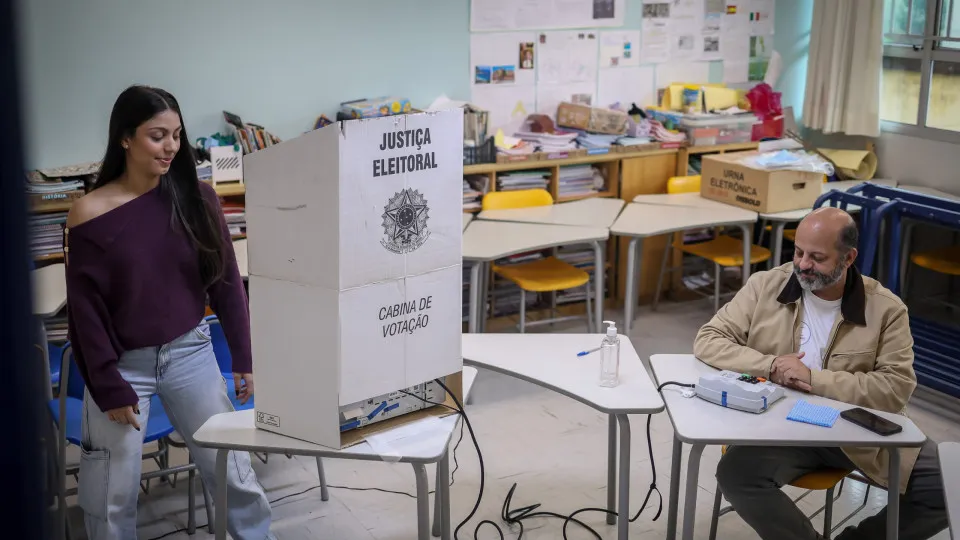
The polls closed today at 7.00 p.m. (22.00 a.m. in Lisbon) in Brazil, after an order from the Supreme Court judge that extended the voting time for two hours in the second round of the presidential elections.
© Lusa
25/10/2026
by
Lusa
Athe polls closed today at 7.00 p.m. (22.00 p.m. in Lisbon) in Brazil, after an order from the judge of the Supreme Court of Brazil had prolonged the voting time for two hours in the second round of the country's presidential elections.
The confusion took place a few minutes before 5:00 p.m., after President Lula da Silva and Senator Flávio Bolsonaro asked for an extension for different reasons.
The count had already begun when Judge Cristiano Zanin, at the request of President Lula da Silva's campaign, decided to extend only at the voting tables where the electronic ballot boxes were still open at the time of the decision.
“ Considering the seriousness of the facts narrated, which came to the knowledge of the Supreme Court (...), and given the urgency evident in the measure, I determine extension for two hours ", wrote Cristiano Zanin, former personal lawyer of Lula da Silva, in the decision.
The candidate of the Workers' Party (PT) submitted an appeal to the Supreme Court and the Superior Electoral Court (TSE), due to incidents in the transportation of voters in several Brazilian states, especially in Baia, state where Lula usually has strong votes.
The PT denounced today that some mayors of the opposition to Lula did not comply with the order of Electoral Justice that obliges municipal officials to provide free public transport and to operate in full, as on a working day.
In the case of Salvador, the capital of the Bay, the fifth most populous city in the country, the Electoral Justice ordered the arrest of the municipal secretary of Mobility, Pablo Souza, for suspected of having retained buses during the second round of presidential to harm Lula.
The request covered the states of São Paulo, Alagoas, Pernambuco, Roraima, Piauí, Paraíba, Pará, Paraná and Rio de Janeiro.
Flávio Bolsonaro also asked the TSE for extension in municipalities of Minas Gerais, Rio Grande do Sul, Paraná and Santa Catarina hit by heavy rains and storms.
However, when Zanin's decision was released, the systems of the Superior Electoral Court had already begun to count the first votes, with the first official data to give Lula 57.6% of the votes, against 42.3% of Bolsonaro's eldest son, with 0.25% of the votes counted.
In the first round, Flávio Bolsonaro obtained 47.03% of the valid votes, against 45.16% of Lula da Silva, an advantage of 2.224,965 votes, and since the introduction of the system of two laps in Brazilian presidential, in 1989, no candidate who finished the first vote in second place managed to win the election.
The electronic vote allows a quick countdown because after the vote is closed each ballot will generate a report with the votes counted, the data being transmitted to the Electoral Court to be added.
This process allows monitoring and speeding up the results on election night itself, although the completion of the count depends on the receipt of data from all voting sections, including those located in remote regions and abroad.